AC Installation · 8 min read
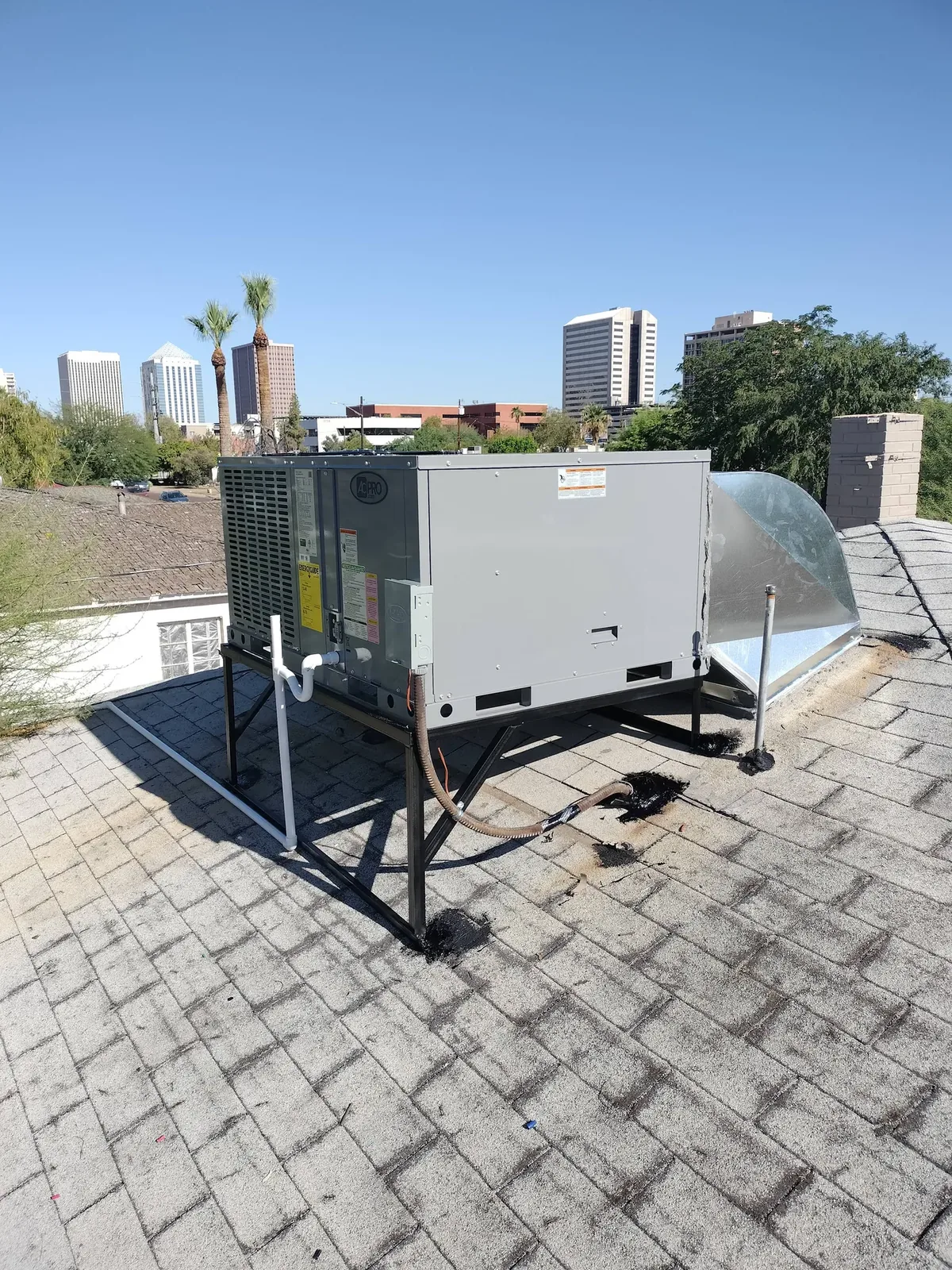
A homeowner in the West Valley called us late last summer with a rooftop packaged AC unit that could not keep up. It ran all afternoon, the house sat at 82, and the unit was old enough that parts were getting hard to find. Replacing a packaged unit on the roof is a different job than a ground-level swap, and that Glendale-area home is a good window into how it actually works.
This post is the educational version, told through a real job. If you are ready to hire and want the straight rundown of how we install and replace systems, that lives on our AC installation and replacement page. Here we will walk through why your AC sits on the roof, what a packaged unit even is, and the parts of the job most homeowners never see. That means the crane, the curb, the duct transition, and the seal that keeps the monsoon out of your ceiling.
If you grew up somewhere with basements, a rooftop AC looks strange. In the Phoenix metro it is normal, and there are good reasons for it.
Most homes here are slab-on-grade. No basement, no crawlspace, nowhere underground to tuck a furnace and coil. The builders had to put the equipment somewhere, and on a lot of tracts the cheapest, simplest place was up top. A rooftop packaged unit also frees up the side yard. On the small lots common across the metro, that matters, because there is no condenser taking up a four-foot strip next to the fence.
It also lines up with how the house was built. On many of these homes the ductwork already runs through the attic or drops straight down from the roof, so putting the unit up top keeps the duct runs short and direct. You will see this all over Sun City, across Peoria, and in the older Glendale tracts, especially on flat and low-slope roofs where setting a unit up there is straightforward.
This is the question we get most, so let's keep it plain.
A packaged unit puts everything in one cabinet: the compressor, the condenser coil, the evaporator coil, the blower, and often a gas heat section, all in a single box on the roof. One unit, one cabinet, one location.
A split system splits the job in two. The condenser sits on a pad on the ground, and a separate indoor air handler or furnace with the evaporator coil lives in a closet, garage, or attic. A copper line set connects the two. If you want the full story on those, we cover it in our write-up on a split-system AC replacement in Phoenix.
When does each make sense? If your home was built for a packaged unit, with the ducts already routed to the roof, staying packaged is usually the clean choice. Split systems work well when you have a good spot for an indoor air handler and a place on the ground for the condenser. The real Arizona trade-off with a rooftop packaged unit is sun exposure. That cabinet bakes on the roof at 150-plus surface temperatures all summer, which is hard on it, while a ground condenser in a little shade has an easier life. It is a trade-off, not a dealbreaker, and good equipment is built for our heat.
Sometimes, but not usually, and we will not pretend otherwise. Converting from packaged to split means finding interior space for an air handler, running a new line set, reworking the duct connections, and adding a ground pad and electrical for the condenser. On a slab home with no obvious indoor spot, that gets expensive fast for no real gain. Most of the time the honest answer is to stay packaged and put a quality unit up there. If your floor plan and ducting actually support a conversion, we will tell you, and you can compare it against the split-system path in the post linked above.
Two common flavors of rooftop packaged unit run in Phoenix. A gas/electric unit cools with electricity in summer and heats with a small gas burner in winter. A heat-pump unit is all-electric and runs the refrigerant cycle backward to make heat, no gas needed.
Plenty of Phoenix homes run gas/electric packaged units, partly because winters here are mild and the gas heat is cheap to run for the few cold weeks we get. Heat pumps are a solid all-electric option, especially for homes without a gas line. How do you know which you have? Look for a gas line going into the cabinet and a flue. A gas connection means gas/electric. No gas line, all-electric, usually means a heat pump. If you are not sure, that is one of the first things we confirm on a free estimate, and it shapes the right replacement for your home.
Here is the West Valley job in short, with real details and honest ranges instead of a fake flat price.
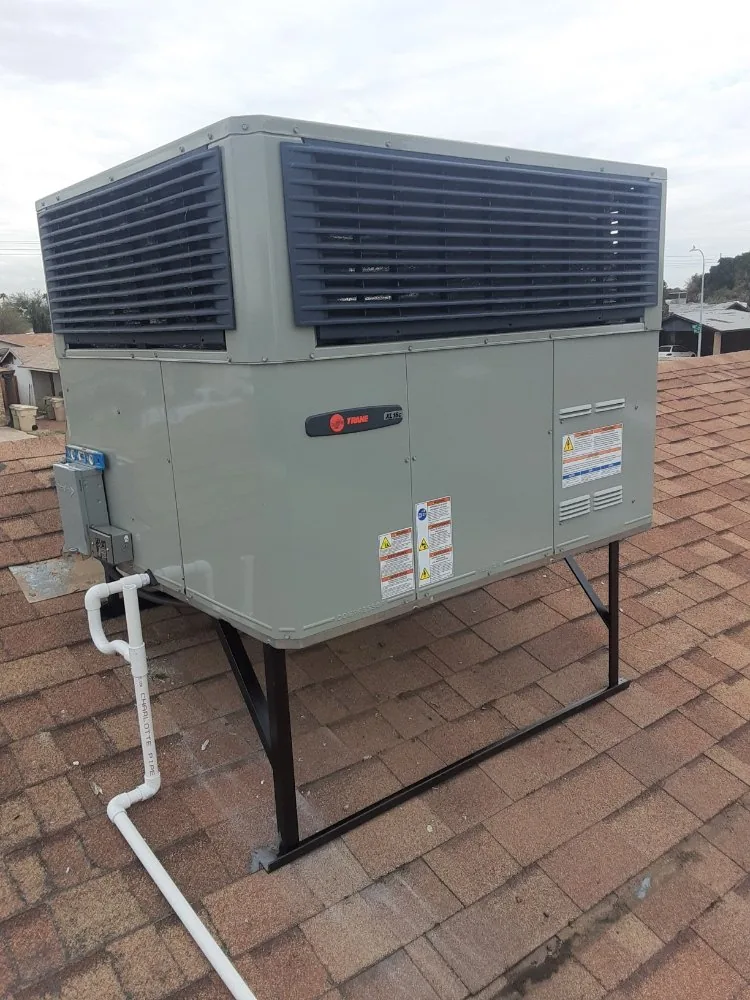
The unit you see in the photos is the easy part to picture. The work that decides whether the install lasts happens underneath it.
A residential packaged unit is heavy, often a few hundred pounds. How it gets on the roof depends on size and access. Bigger units, or roofs with no clear path, get a crane. The crane lifts the old unit off and sets the new one in minutes, which is safer and easier on your roof than dragging weight across it. Smaller units on accessible single-story roofs can sometimes be hand-hoisted with a ladder hoist and a crew. We size up access during the estimate so there are no surprises on install day. For this West Valley home, the weight and the layout made a crane the right call.
The roof curb is the raised frame the unit sits on. It does two jobs. It holds the unit up off the roof surface, and it routes the supply and return air down through the roof into your ducts. The catch is that a new unit almost never lines up perfectly with the old curb. Cabinet sizes change between models and brands, and the supply and return openings move. Force a mismatched unit onto an old curb and you get air leaks, weak airflow, and a roof that wants to leak. The fix is a curb adapter, a custom transition piece that mates the old roof opening to the new unit's footprint. We fabricated one on this job so the Trane sat clean and sealed on the existing opening.
Right below the curb, the unit's supply and return openings have to meet your existing ductwork. If those do not line up, you choke airflow, and a choked system runs hot and works harder in 110-degree heat. We build a sheet-metal duct transition so the new unit's openings match the existing duct cleanly. Get this right and the new unit moves the air it was designed to move. Get it wrong and even a great unit underperforms.
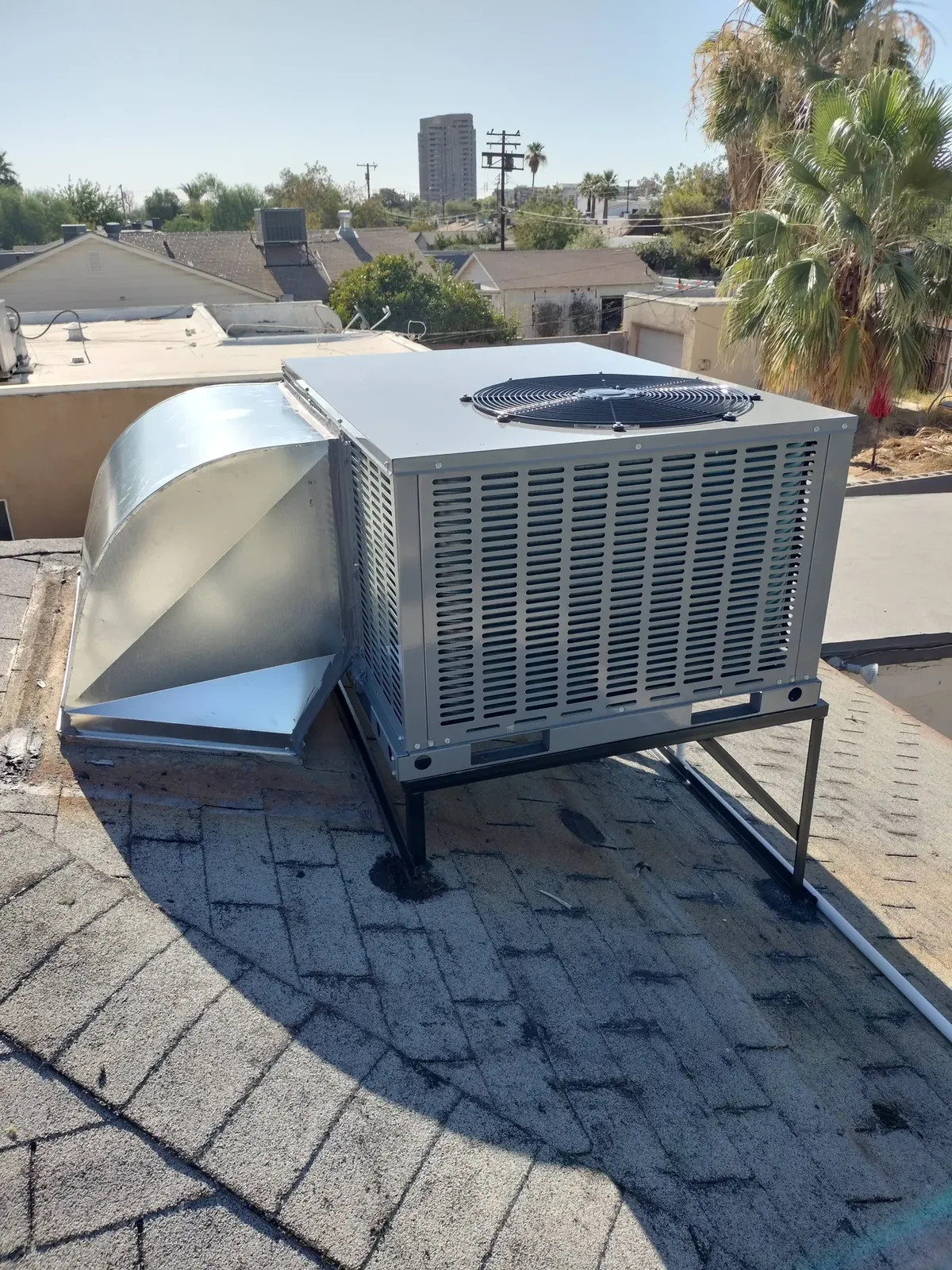
Anytime you cut into a roof, you create a path for water. In Phoenix that path stays dry ten months a year and then gets hit hard during monsoon, when an inch of rain can fall in an hour with wind driving it sideways. A sloppy seal in April becomes a brown ceiling stain in July.
Sealing it right means matching the method to the roof. We seal the curb to the unit, run mastic and gasket where the cabinet meets the curb, and on flat and low-slope roofs we foam the penetration and tie it back into the roof coating so water has nowhere to sneak in. The goal is one continuous, weathertight surface from the unit down through the roof.
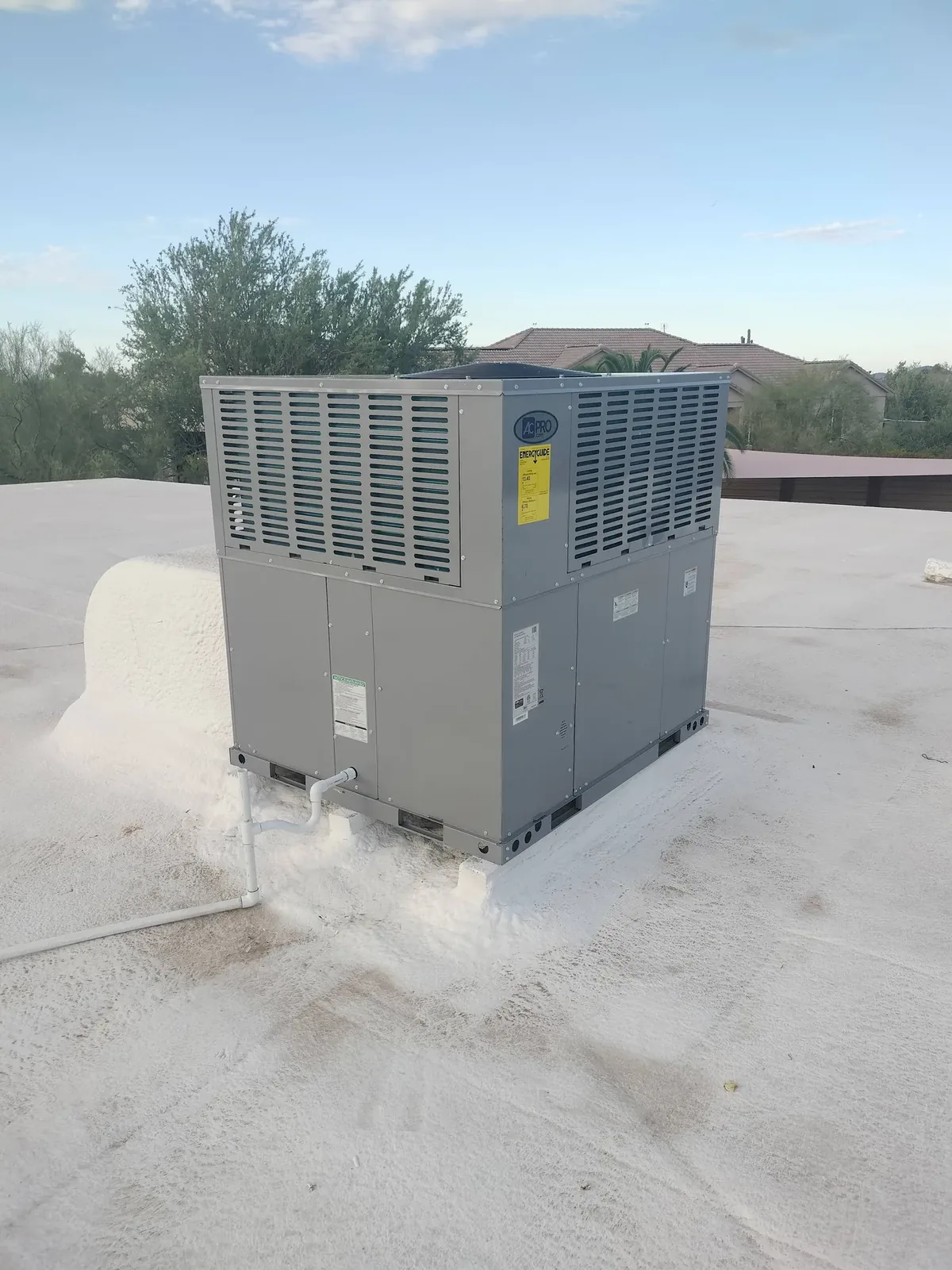
We also work clean. We wear booties indoors, we keep the job tidy, and we haul away the old unit so you are not left with a rusty cabinet on your roof or in your driveway. You can see more finished work like this in our project gallery.
It is tempting to think a bigger AC cools better. In our climate the opposite is often true. The right size comes from a Manual J load calculation, which is the industry method for figuring out how much cooling your specific home needs. It accounts for square footage, ceiling height, insulation, windows, roof exposure, and our brutal design day, the 110-plus afternoons we size for.
Tonnage is the cooling capacity (one ton equals 12,000 BTU per hour). SEER2 is the efficiency rating under the current federal test, so a higher SEER2 unit uses less power to deliver the same cooling. An oversized unit cools the air fast, satisfies the thermostat, and shuts off, then kicks back on a few minutes later. That is short-cycling, and it wears out parts, wastes energy, and never runs long enough to pull humidity out, which matters during our humid monsoon stretch. A right-sized unit runs longer, steadier cycles, holds temperature better, and lasts longer.
This is where experience earns its keep. Alex, our owner and lead tech, has more than 16 years in the trade and works under AZ ROC #343485 (C-39 and CR-79). He sizes by the numbers, not by guesswork or by matching whatever was up there before, because the old unit may have been wrong from day one.
We do not post a flat price, because an honest number depends on your home. Here are the real factors that move it:
The way to get a real number is a free estimate. We come out, measure, run the load calc, look at your roof and access, and give you an honest, up-front price with no pressure. We often beat other estimates homeowners bring us, and we will tell you straight if a repair makes more sense than a replacement. Call or text Alex at 480-853-6627, or send the details through our free estimate form and we will get right back to you.
We are a family-owned HVAC contractor based in Glendale, serving the West Valley and the wider Phoenix metro. We are licensed, bonded, and insured under AZ ROC #343485 (C-39 and CR-79), with more than 16 years of hands-on experience and a 5.0 rating across our reviews. You get honest up-front pricing, fast response, and clean installs from a tech who treats your roof and your home like his own. If you want to compare options before you decide, our AC installation and replacement services lay out the full picture, and we are always happy to talk it through.
If your rooftop packaged unit is aging out, struggling through the afternoons, or just not keeping the house comfortable, reach out for a free estimate and we will walk your roof with you. While you are weighing options, you can read how a ground split-system replacement compares, or see why a ductless mini-split install is the right answer for additions and hard-to-cool rooms. When you are ready, browse our recent installs or get in touch and let's get your home cool for the summer.
There is no single flat price, because the cost depends on your home. The biggest factors are tonnage and efficiency (SEER2), whether the unit needs a crane, whether a curb adapter and duct transition are required, electrical and disconnect upgrades, permits, gas versus heat-pump heat, and the condition of your roof. The honest way to get a real number is a free estimate. We measure, run the load calc, check access, and give you an up-front price, and we often beat other estimates.
Not always. It depends on the unit's size and weight and how accessible the roof is. Larger units, or roofs with no clear path, get a crane because it is safer and easier on your roof than hauling weight across it. Smaller units on accessible single-story roofs can sometimes be hand-hoisted with a crew. We size up access during the estimate so there are no surprises on install day.
The roof curb is the raised frame your unit sits on. It holds the unit off the roof and routes supply and return air down into your ducts. A new unit almost never lines up perfectly with the old curb, because cabinet sizes and opening locations change between models. A curb adapter is a custom transition that mates the old roof opening to the new unit, so it fits, the air flows right, and the roof stays sealed against leaks.
Sometimes, but usually it is best to stay packaged. Converting means finding interior space for an air handler, running a new line set, reworking the duct connections, and adding a ground pad and electrical for the condenser. On a slab home with no good indoor spot, that gets costly with little gain. If your floor plan and ducting actually support a conversion, we will tell you honestly and lay out both options.
For a straightforward residential job, plan on a one-day swap. We recover the old refrigerant, remove the old unit, set the curb adapter and duct transition, set and connect the new unit, handle the electrical, seal the penetration, charge and commission the system, and test it before we leave. Heavier duct repairs or a difficult roof can add time, and we tell you up front if that is the case.
Only if the curb and penetration are sealed wrong. Anytime you cut into a roof you create a path for water, and Phoenix monsoon storms test it hard. We seal the curb to the unit, run mastic and gasket where the cabinet meets the curb, and on flat or low-slope roofs we foam the penetration and tie it back into the roof coating. Done right, it is one continuous weathertight surface and it stays dry.
That comes from a Manual J load calculation, not a guess and not by matching whatever was up there before. It accounts for your square footage, insulation, windows, roof exposure, and our 110-plus design day. Tonnage is the cooling capacity and SEER2 is the efficiency rating. Bigger is not better here, because an oversized unit short-cycles, wastes energy, wears out faster, and never runs long enough to pull humidity during monsoon. We size it right so it runs steady and lasts.
Get a free, no-pressure estimate from a licensed local HVAC contractor. Call or text and we'll get you scheduled fast.